
Posted byWomen Writing the West
By Heidi M. Thomas
I want to tell you a little secret: Nobody writes a perfect first draft.
Not Shakespeare. Not Mark Twain. Not Stephen King.
Nobody. (Hemingway once said: “There are no great writers, only great re-writers.”)
Why hire an editor? Do you want your book to be the best that it can be?
Editors are useful to authors because it’s almost impossible to be objective about your own work. As the creator, writers “fill in the blanks” of what’s actually on the page versus the vision in their head.
Y0UR M1ND 15 R34D1NG 7H15 4U70M471C4LLY W17H0U7 3V3N 7H1NK1NG 4B0U7 17.
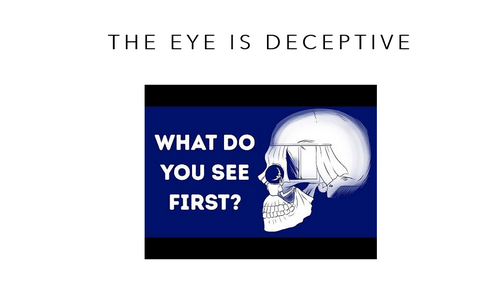
No matter how eagle-eyed we may be, it’s easy to see on the page what we intended to say, rather than what we’ve actually said. Have you written a character named BRIAN and you keep typing BRAIN?
Even editors need editors. I can personally attest to that! My editor finds so many little things that I, as an editor, point out to my clients—repeated words, typos, misplaced commas.
Because your spell checker is not infallible. The easy answer is that even if you use a spell checker, there are a lot of bloopers it simply won’t catch because the words are actually spelled correctly. For example, one editor worked at a big national non-profit organization, and the final, critical step before any of their promotional material went out was to check, manually, that none of it contained the phrase “pubic education” where it should have said “public education.” Oops!
Here are just a few of the basic things that a competent editor can and should do to your work, for starters:
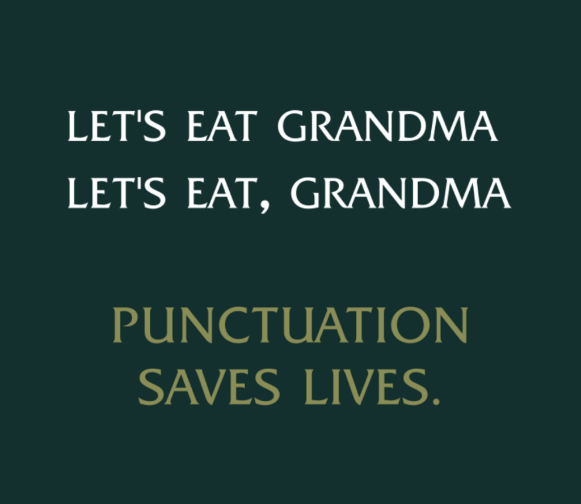
- Fix grammar, punctuation, and spelling errors.
- Replace passive verbs with active ones (“the gun was fired by the robber” becomes “the robber fired the gun.”)
- Mend run-on sentences
- Root out “wordiness” (i.e., help you get to the point more economically)
- Make sure you’ve made the point(s) that you set out to make
- Story flow
- Character arc
What Can YOU do?
Read it aloud. Watch for:
- Passive sentences Go through your writing and find instances where something happens to the subject (passive) and change them to the subject making something happen (active). For example, “This class was taught by me,” can be changed to the active, “I taught this class.”
Words that often signal passive construction: has, had, was, were and that. Example: There was a mutter from the witnesses becomes The witnesses muttered.
- The way you portray thoughts.
Old: This isn’t happening, Jinx thought.
New: Jinx blinked. She blinked again. It didn’t help. This isn’t happening. (Action signifies who is thinking. Don’t need the tagline thought.)
Dialog tags. Fewer “saids.” Whenever possible, use an action or a reaction. It’s stronger, helps develop character, emotion, and moves the story forward.
- Omit Useless Words:
That (there is no doubt that… becomes:…no doubt…)
very
really
truly
absolutely
totally
suddenly
starting to
began to
as
even
just
there
- SHOW don’t TELL Without context, words like “beautiful/ugly” and “delicious/disgusting” are meaningless. We’ve all seen the word amazing a thousand times. Try astonishing, astounding, blindsiding, dumbfounding, eye-opening, flabbergasting, or use description to show what it looks like/how it feels. The more common the word, the more readers will overlook it—and your writing. Keep a thesaurus handy and switch out pedestrian words (sad, glad, happy, excited).
Can you SHOW it through the character’s reactions/feelings? - Simplify your sentences wherever possible. Watch for redundant or unnecessary phrases. As writers, we need to “show, not tell” as often as possible. Yet, some writers tend to show and then tell the same information, which is redundant. Watch out for this in your manuscripts. Also, look for the redundant phrases below and others like them.
Stand up = stand
Sit down = sit
Turned around = turned
He thought to himself = He thought (or eliminated altogether by using an action)
She shrugged her shoulders = she shrugged
She whispered softly = she whispered
He nodded his head = he nodded
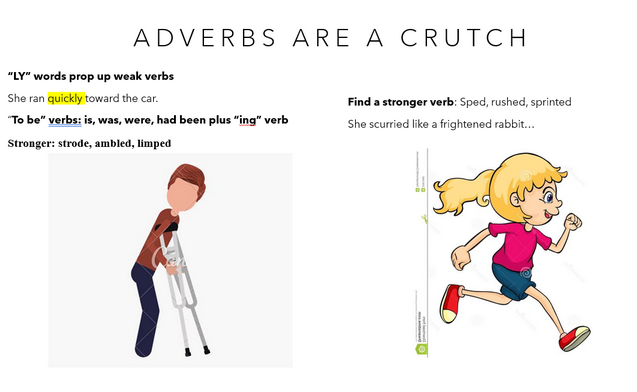
Avoid adverbs for the most part. They’re a crutch to prop up weak verbs. Use strong, descriptive verbs instead.
Example: She smiled slightly at the photographer.
Better: She grinned at the photographer. OR She quirked her mouth upward… OR She gave the photographer a shy smile.
Avoid repeating words. Go back and reread each sentence. Have you used the same word several times within a single sentence or paragraph or on the page? If so, substitute another word with the same meaning.
Limit the description in a dialogue tag. Beginning writers tend to load down the dialogue tags (the “he said, she said” part of the dialogue) with too many details. If you must describe what a character is doing AS he says something, put that information in a separate sentence, not in the dialogue tag. (example: …she said as she backed out of the room becomes: She backed out of the room). No tagline. Keep it short. Be careful when trying to avoid too many “saids”—you can’t laugh, smile, spit, snarl, or grouse words.
Revision & Polish Tips:
1. Keep the focus, the theme, of the piece consistent throughout.
2. Sentence structure: a subject—a noun or pronoun, and a predicate/verb that explains what the subject is doing.
3. Use nouns rather than adjectives and remove overused adjectives such as very.
4. Verbs are where the action is—choose strong ones.
5. Avoid adverbs that diminish the strength of a sentence.
6. Vary sentence length and rhythm within the piece.
7. Make it personal and professional, convey the message, be specific.
Then, when you have polished your manuscript to the best of your ability, send it to a professional editor, even if you plan to submit to a publisher. You won’t be sorry.

…is a freelance editor and WILLA and Will Rogers Medallion-award winning author of 12 books.
She grew up on a working ranch in eastern Montana, riding and gathering cattle for branding and shipping. Her parents taught her a love of books, and her grandmother rode bucking stock in rodeos. She followed her dream of writing, with a journalism degree from the University of Montana.
Her books are featured on her website and on Amazon. Find her on Facebook, too.
 Lilac City Rochester Writers