Midnight Confessions

by Donna Collins

Over the years, as a nurse, I’ve done my share of shift work. A lot of that was on the ‘graveyard shift’—eleven-to-seven working with a pared down crew. The time between two and four in the morning were known as the ‘witching hours.’ 

To fight the fatigue, one consumes copious amounts of coffee while struggling with the workload. Those were also the hours when people seemed to be most vulnerable. While most turned anxious thoughts inward, a few found the need to unburden. I referred to these admissions as midnight confessions. 

I remember several heartbreaking revelations shared in confidence. Secrets so painful and despair so deep that they could no longer be contained. Stories I can never repeat. 

Often, I had no words of wisdom, no advice, or even encouragement, but none were needed or wanted. These poor souls only wanted to be heard. So, I did the only thing I could. I listened.

I wasn’t a writer then, but even now, decades later, I will not share their stories. Their brave words belong to them and only them. But as a writer, I can take inspiration from their experiences.

What I have learned is crushing circumstances require strong believable characters, so I can build on the survivor’s traits in my fiction. Strong men can, and do cry. Broken women heal. People, thankfully, are incredibly resilient. 

The range of emotions I witnessed also can be woven into my writing. Sorrow, sadness, betrayal can transition into hope, joy, and acceptance.

I can assure you that no matter what situation I put my characters through, I will always try to provide a happy or at least a gratifying ending. Characters, real or fiction, deserve nothing less.

When Your Writing Matters

By Kim Gore

I grew up reading a very simple but joyful series called Dick and Jane. What I loved about these books with their 1950’s attired children, rosy-cheeked and naïve, wasn’t the storylines. In fact, I don’t think I could give you one plotline gleaned from the series. The stories weren’t memorable. They were told in short sentences. Nothing special or fancy. Just readable for a first grader. But I loved that the pictures helped tell the story. The children’s expressions ranged from gleeful to sour to upset.  Even before taking in the story word by word, I loved the emotions drawn on the page. It was as if watching a play, but with two-dimensional humans that spoke inside my head instead of a stage. I took to writing my own stories, using my own drawings. But my skill was limited in both departments, being that I was in public elementary school.

My Cousin Helen took my sister and me to see theatre productions. Hello Dolly. Peter Pan. The Nutcracker. Enthralled, I began to write plays. My sister and I performed them for our relatives during holidays. I was still just a little kid, not even a teenager. But to be able to make those words come alive through performance thrilled me. Again, evoking emotion from words. Facial expressions. Arm movements.

When I was fifteen, my mother introduced me to Christopher Pike. Or, at least his books. I opened up to a world of shocking horror. Teenagers, like me, with problems, like I had…and then a twist! Murder. (I don’t think my mom realized these were more or less horror novels, but…) I was shocked to read books about teens getting revenge on other kids in the most horrific of ways. Dick and Jane never did these terrible things.

But I loved it.

I immediately began filling up pages and pages with crazy, unhinged adolescents. My imagination had been released, and now I wrote novels. I didn’t care that they weren’t going to be published. Or read by someone else. I wrote for the sheer joy of creating. Inventing. Discovering where my mind wanted to go. While kids went to parties or stayed out past midnight drinking, I was in my room, scribbling away. Encouraged by my parents, who understood creativity well, as they were both prime examples of being artists in their own right.

In high school and college, I acted in plays. Again, loving every moment of evoking emotion, spilling it out beneath bright stage lights and the watchful eyes of a rapt audience. I took theatre classes in college, including a scriptwriting class. And over a weekend, I wrote a play my mom titled Something Blue. Long story short, I had it approved by the college to put onstage in their Blackbox Theatre. They gave me a stipend to use for supplies. I had a team that helped me. I directed it. We had full houses every night of the production. I sat watching the performance, listening to the audience laugh at all the right places, become silent when intense words spilled out of the actors’ mouths. People left the theatre crying, which I hadn’t expected. It had a sad ending. People felt that. I made people feel. They laughed! They cried! One person, an actor’s father, was shocked someone so young had written it.

I knew then that I wanted to be a writer.

It wasn’t that I wanted fame, to be noticed, or money. I mean, sure, I would have liked all that. But what made an impact was the way people responded. Like how I responded all those years ago after reading a story. It wasn’t the plot that held me captive. It was how the story made me feel. The way it touched me. Reached out with invisible fingers and nudged my heart. That was why I was so captivated with Dick and Jane. Watching Peter Pan. Reading Christopher Pike’s Chain Letter.

If you can make your audience feel, they will remember. And that’s been my motivation for storytelling (and my music, my art) ever since.
How I Started Writing Fiction

by BarbaraHelene Smith

I had no prior experience writing fiction, but when I received an Extension Course catalogue in the mail, I reviewed the offerings and identified a six-week summer creative writing class. On a
whim, I drove to the school and registered. When I returned to the car, I sat frozen, questioning my decision — “What did I do? — I’m not a writer!”

Initially nervous and apprehensive about my abilities, I gradually developed an appreciation for the assignments and the collaborative process of sharing and refining my stories.

When the course ended, I realized my growing enthusiasm for writing, and subsequently joined a group of dedicated writers at another class at a local college. When the college discontinued the
course, six of the students from the class formed a critique group, and within the first year, each of us had a story published. Several years later, four of my short stories which centered on a
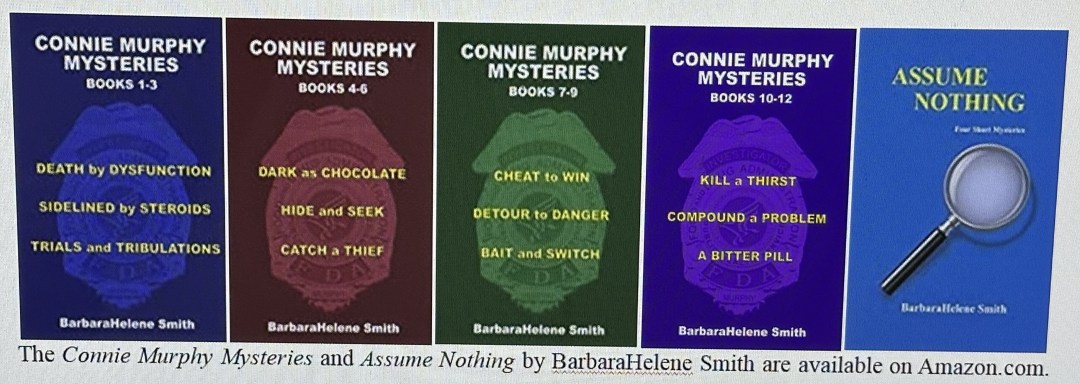
common theme — Ordinary women finding themselves in extraordinary situations while searching for the truth — formed the basis for my publication, Assume Nothing, marking the beginning of my fiction-writing vocation.

After relocating from California to New York, I joined the Lilac City Rochester Writers, an organization dedicated to improving the skills of writers at all levels. Since joining LCRW, I have published a series of Connie Murphy Mystery eBooks, based on my seventeen years as an investigator with the U.S. Food and Drug Administration.

And to think, it all began by taking a chance on a six-week creative writing course.


Assume Nothing and the Connie Murphy Mysteries by BarbaraHelene Smith are available at Amazon.com as eBooks and paperbacks.

John Caligiuri’s New Release

Maelstrom Unleashed Book 3 of Novaroma series

In a distant corner of the galaxy, where humanity’s exiled descendants have forged the resilient Novaroman Republic, an interstellar war brews after four hundred years of uneasy peace.

Captain Gabriel Carloman, a forgotten heir to a fallen imperial dynasty, uncovers a sinister incursion deep within Novaroman territory by a species who called themselves, Ipis. The purple-scaled conquerors—derisively called “harpies” by humans—launch a devastating surprise attack, shattering the fragile peace and threatening to extinguish humanity’s very existence. Rising from the rank of a backwater frontier guard commander, Gabe rallies the fractured human fleets and forges alliances with enigmatic alien species.

However, cunning tactics and audacious raids are not enough against an implacable foe with unlimited resources. Ancient secrets, sentient machines from a forgotten Earth, and shadowy galactic politics collide in a desperate bid for survival.

In Maelstrom Unleashed, the third explosive installment of John Caligiuri’s Novaroma Series, heroes must navigate betrayal, innovation, and the void’s unforgiving fury. Will Gabe’s unyielding resolve rewrite humanity’s destiny, or will the harpies’ manifest destiny claim the stars? Epic space opera meets historical intrigue in this tale of empires clashing and legends born.

Sue Savard has a new book out

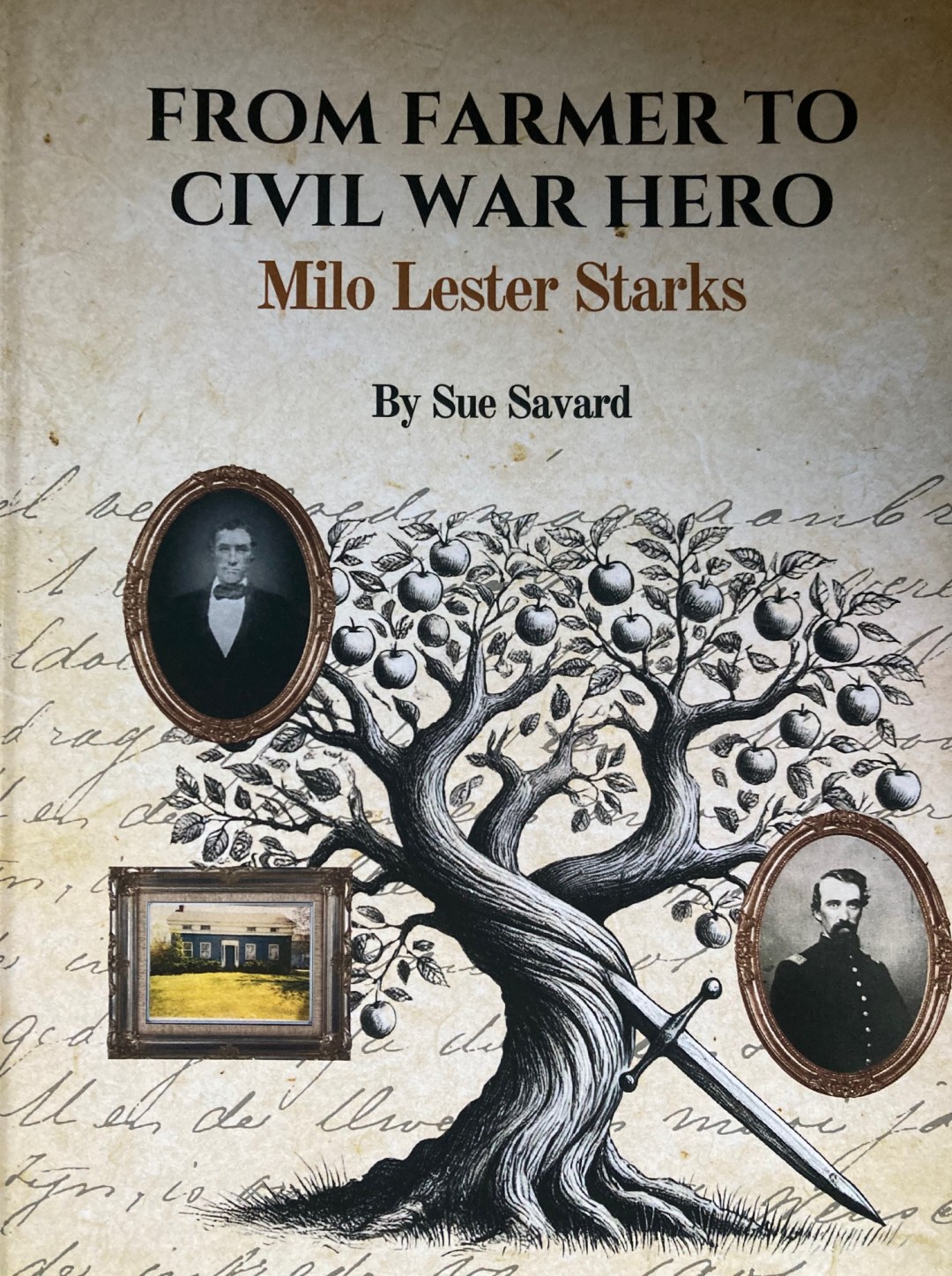
FROM FARMER TO CIVIL WAR HERO
A brand-new book by Sue Savard about the part played in the Civil War by the town of
Sweden’s local hero, Milo Lester Starks, is now available at the Lift Bridge Bookshop.
The story was taken from his letters to family and friends and brings to light his inner
fears and feelings, love of family, admiration of President Lincoln, and his interactions with and
admiration for the black volunteers from both north and south.
He soon made his mark as a successful recruiter of local young men, an admired Major,
who was a strict but understanding mentor of those in his company, fearless fighter at the
Battle of Little Round Top, and the glue that kept his family together.
As well as portraying Milo’s part in history, the book also shines light on the history of
the town of Sweden, its residents, the state college at Brockport, and the importance of the
Erie Canal.